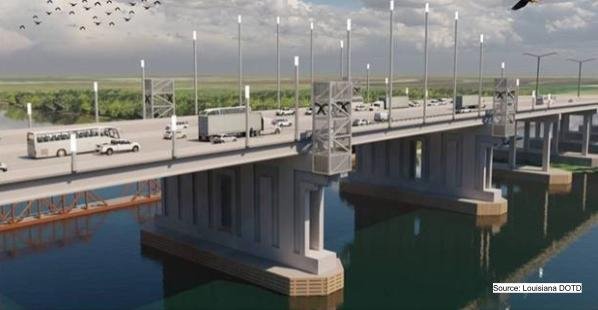
Lake Charles, Louisiana - The Louisiana Department of Transportation and Development has approved the baseline construction schedule for the I-10 Calcasieu River Bridge Replacement Project, marking a significant step forward for one of the state’s most closely watched infrastructure efforts.
Since reaching financial close in August 2024, the project team has completed several early milestones that clear the way for major construction to begin in spring 2026. The work is part of a broader push to modernize a critical segment of Interstate 10, support economic activity in Southwest Louisiana, and improve long-term safety and reliability on a key Gulf Coast freight and commuter route.
Officials report that the project is now moving steadily through the design and permitting phases, with an emphasis on building a modern, resilient structure that can serve the region’s transportation needs for decades.
Key Milestones Already Completed
According to project information, several foundational tasks are already finished, allowing the team to move from high-level planning toward more detailed engineering and early-site work. Completed items include:
- Phase I geotechnical investigations:
Early subsurface testing and soil analysis have been carried out to better understand ground conditions. These investigations help engineers design bridge foundations and embankments that can safely support heavy traffic and withstand river and weather conditions. - Closure at Exit 27 on I-10 westbound (LA 378 Westlake):
Exit 27 has been closed to allow the relocation of an overhead pipe rack. Clearing conflicts like this is necessary to make room for the new alignment and construction staging areas. - Final right of way maps approved by the Louisiana Department of Transportation and Development:
Right of way maps define the land needed for the project. Their approval is a critical administrative step that allows the state to move forward with property acquisition and utility relocation. - U.S. Army Corps of Engineers permit approval:
This federal permit is required for work that affects wetlands and waterways, including river structures and embankments. Approval indicates that the project has met environmental and navigational standards under the Corps’ review. - U.S. Coast Guard permit approval:
Because the bridge crosses a navigable waterway, the Coast Guard reviews vertical clearance and navigation impacts. The permit signals that the new structure’s height and placement have been accepted for river traffic. - Wetland mitigation and vertical clearances:
The project has advanced wetland mitigation measures and confirmed key vertical clearance requirements for both highway and river uses. Mitigation typically involves compensating for unavoidable wetland impacts through restoration or preservation efforts elsewhere.
Collectively, these steps move the project from conceptual planning into the realm of enforceable permits and defined construction parameters.
Major Work Now in Progress
While full-scale construction is not expected until spring 2026, a broad range of project activities is already underway. Current work includes:
- Finalizing interim design:
Engineers are refining design packages for early phases of work. Interim design often focuses on elements that must be built or relocated first, such as temporary alignments, early foundations, or major utility shifts. - Utility coordination and relocation:
Coordination with utility owners is ongoing to plan and execute the relocation of lines that conflict with the new bridge corridor. This includes power, communications, and other underground and overhead systems that must be moved or protected. - Phase II geotechnical investigations:
Additional, more detailed subsurface investigations are being performed to validate design assumptions from Phase I and support final engineering decisions. These tests can include deeper borings, lab testing, and field measurements. - Right of way acquisition:
With right of way maps approved, the project has entered the acquisition phase, in which the state secures the necessary land and property interests for construction. - Common duct bank installation:
A central feature of the utility strategy is the creation of a common duct bank—a shared underground concrete conduit that houses multiple utilities together. This structure streamlines placement and provides a single coordinated pathway for lines that were previously scattered across the corridor. - Hauling embankment:
Material is being brought in and prepared for future embankment construction, which will support approach roadways on either side of the new bridge. - Test piling:
Test piles are driven into the ground to measure load capacity and settlement behavior. Results help verify that the planned foundation system will perform as expected under traffic and environmental loads. - Tree clearing:
Clearing vegetation in selected areas creates safe access for crews, equipment, and test operations and prepares the corridor for more intensive work. - Limited commencement of construction:
Some early construction activities, such as minor structures, test elements, or preparatory work, are beginning under the “limited commencement” phase. These efforts lay the groundwork for the larger, visible bridge and roadway construction anticipated in 2026.
Project leaders emphasize that these activities are part of a carefully staged rollout rather than full, continuous construction. However, they represent the visible shift from planning toward real-world implementation.
Consolidating Utilities in a Common Duct Bank
A major enabling component of the I-10 Calcasieu River Bridge Replacement Project is the redesign of underground utilities within the project corridor.
Previously, many utility lines were spread out beneath and around the bridge approaches, often crossing and overlapping in ways that conflicted with the new highway alignment. To address this, the project is consolidating those lines into a single shared duct bank—a reinforced, underground concrete structure containing multiple utility conduits in an organized layout.
This approach serves several purposes:
- Clearing the way for bridge construction:
By moving utilities into a defined corridor, contractors reduce conflicts with foundation work, embankments, and new roadways. - Improving long-term maintenance:
A dedicated duct bank makes it easier for utility crews to access, inspect, and repair lines without extensive digging or repeated disruption of the roadway. - Reducing future disruptions:
When lines are grouped and mapped within one structure, future maintenance or upgrades can often occur with fewer lane closures or traffic impacts.
Utility relocation work associated with the duct bank is already underway and is considered a key step in preparing the corridor for the broader transformation that will follow.
Active Transportation Allowance for Bicycles and Pedestrians
The project also includes an Active Transportation Allowance that could support bicycle and pedestrian facilities on both ends of the new I-10 Calcasieu River Bridge.
These potential features:
- Would be located within the design-build limits of the bridge project.
- Are not mandatory components; they depend on the approval of the Louisiana Department of Transportation and Development.
- Fall outside areas otherwise covered by the agency’s standard Complete Streets requirements, which typically guide how roads accommodate multiple travel modes.
If implemented, these facilities could provide new or improved connections for people walking and biking near the bridge, enhancing local access and nonmotorized options. For now, they remain a design allowance rather than a guaranteed part of the final configuration.
Timeline and Next Steps
According to current plans, major construction activities—those likely to be most visible to drivers and nearby communities—are projected to begin in spring 2026. As the project advances toward that date, design will continue to be refined, permits will guide implementation, and early field work will expand.
Officials note that construction and closure timelines are subject to change as the project evolves, reflecting engineering findings, weather, permit conditions, and coordination with local stakeholders.
The project team has indicated that stakeholders and the public can expect continued updates as work transitions from planning to execution. The replacement of the existing structure is expected to bring safety improvements, more reliable connectivity, and long-term support for economic activity in Southwest Louisiana, particularly along a corridor used heavily by both local travelers and interstate freight.
Traffic, Safety, and Economic Context
The I-10 corridor across the Calcasieu River is a vital link for regional commuters, commercial trucking, industrial facilities, and visitors traveling across Louisiana and the broader Gulf Coast. While specific traffic counts and crash statistics were not provided in the project summary, state and regional agencies have long treated the bridge and its approaches as a high-priority segment due to aging infrastructure and heavy use.
By focusing on geotechnical stability, utility coordination, and modern structural design, the replacement project aims to support safer and more efficient travel. In the long run, upgraded capacity and improved reliability are expected to benefit businesses, ports, industrial operations, and communities across Calcasieu Parish and neighboring areas.
As the project progresses, transportation planners and local leaders are likely to monitor how construction staging affects traffic patterns and to coordinate detours and lane shifts to limit disruptions where possible.
What Residents and Drivers Should Know
For residents, commuters, and freight operators in Southwest Louisiana, several themes stand out:
- Preparatory work is already underway, even if large cranes and bridge segments are not yet visible.
- Utility relocations and right of way acquisition are critical precursors to major construction and may drive some short-term closures or access changes.
- The project is designed with long-term resilience and maintainability in mind, notably through the common duct bank and modern foundation strategies.
- Possible bicycle and pedestrian components remain optional and are dependent on further approval by the Louisiana Department of Transportation and Development.
While the full impact of construction will not be felt until closer to 2026, the groundwork being laid now will largely shape how efficiently the bridge can be built and how well it will perform once opened to traffic.